The Permit Question, Answered Straight

There is a live local habit of treating a charger circuit as a minor job — a handyman task, a weekend project, something below the permit threshold. In Gainesville and Alachua County, that is not the rule. A new charger circuit is permitted electrical work: city addresses file through the City of Gainesville, unincorporated addresses — including communities outside the city line such as Haile Plantation — file through Alachua County. The circuit is built to the Florida Building Code and the National Electrical Code, inspected, and closed on the record.
Why insist on this when others wave it off? Because unpermitted work does not stay hidden; it waits. It surfaces when the home sells and a buyer's inspector opens the panel and finds a 240-volt circuit with no record behind it. It surfaces after a fire or an electrical claim, when the insurer asks for documentation the owner cannot produce. And it surfaces the next time an electrician touches the panel and has to price in someone else's unrecorded work. Each of those moments costs more — in money, in delay, in negotiating position — than the permit ever did.
Our Florida EV charger permit guide makes the full case. The short version for Gainesville: the permit is not bureaucracy around the product. It is a substantial part of the product, and any quote that treats skipping it as a saving is offering you a liability at a discount.
GRU Country: The Honest Utility Picture
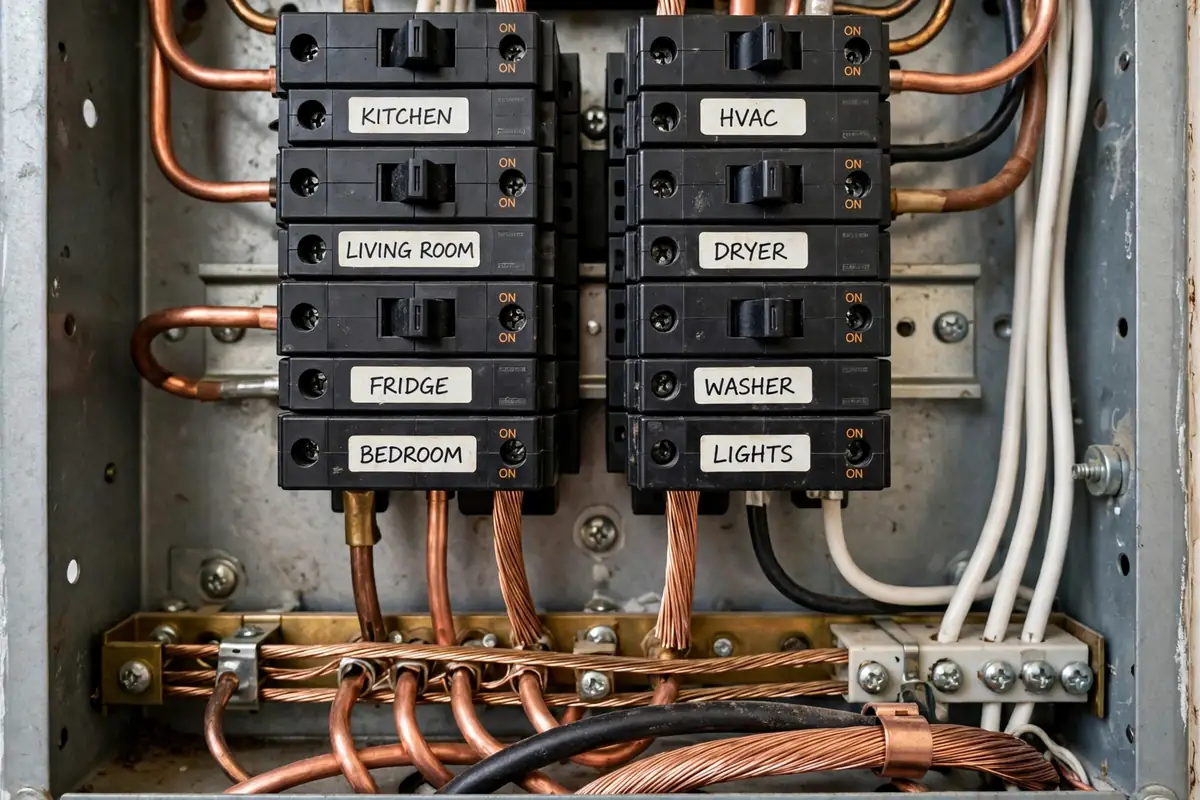
Gainesville's power comes from GRU — Gainesville Regional Utilities, the municipal utility. Consistent with how we work everywhere: we make no rebate or charger-program claims on GRU's behalf, because inventing a program helps no one and misleads homeowners at the exact moment they are budgeting. The established route to home charging in GRU territory is a privately owned charger, professionally installed on your own panel, permitted and inspected as described above.
One GRU fact does belong in the planning conversation, because Gainesville rooftops make it relevant: GRU net metering exists, and solar households here interconnect under GRU's own terms. Homeowners who have read about FPL's EVolution program elsewhere in Florida sometimes arrive assuming its solar exclusion applies to them. It does not — that exclusion belongs to FPL's subscription program, and Gainesville is not FPL territory. Your solar array and your charger coexist under GRU's rules, and the planning question is the practical one covered below: when the car charges relative to when the roof produces. The locations overview shows where Gainesville sits in our wider Florida service area.
EV Charging Services in Gainesville, FL
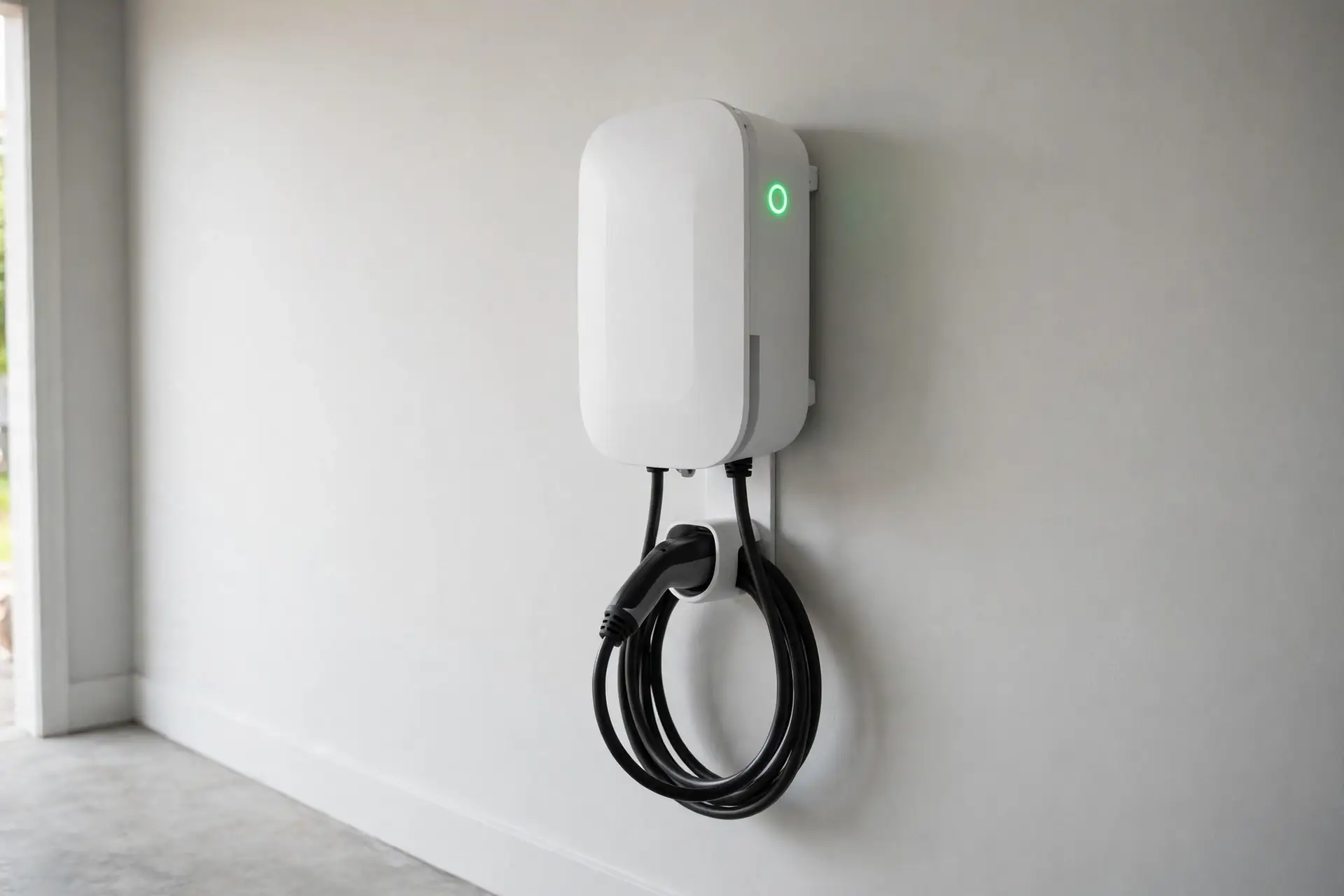
- Residential EV Charger Installation — Home Level 2 installs for historic in-town homes and newer suburban construction.
- Tesla Wall Connector Installation — Wall Connector installs for Tesla households across Alachua County.
- Level 2 EV Charger Installation — 240-volt charging for every EV make, configured to your panel's real capacity.
- Electrical Panel Upgrade for EV Chargers — Capacity answers for older panels, load management considered before replacement.
- Commercial EV Charging Station Installation — Charging for medical-district employers, offices, and multifamily properties.
- EV Charger Repair and Maintenance — Diagnostics and repair for chargers that trip, fault, or underperform — including assessing unpermitted prior work.
Duck Pond Panels and Historic-Home Arithmetic
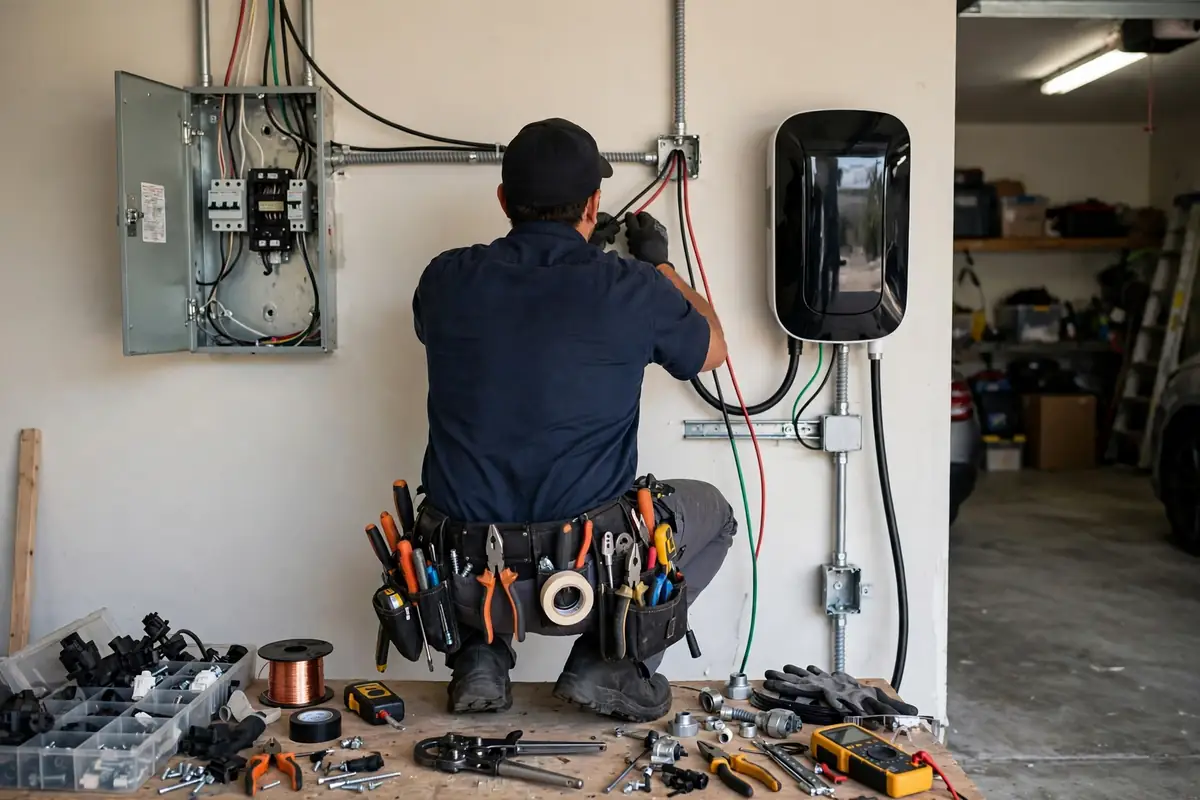
The Duck Pond neighborhood and Gainesville's other historic districts hold the city's most loved houses and some of its oldest electrical systems. A panel installed when the house ran on lights and a stove now faces central air, a modern kitchen, and a vehicle that charges overnight. Owners of historic Gainesville homes tend to hear one of two wrong answers: that a charger is impossible without rewiring the house, or that a panel replacement is automatically required. The load calculation exists to replace both guesses with a number.
Under NEC Article 220, the calculation totals existing demand against service size. Historic homes that have had service work during past renovations often hold more headroom than their owners expect. Tight panels resolve in steps: a charger configured to a moderate amperage that still fills the car overnight, an energy management system that throttles charging while the big household loads peak, and panel or service work only where the arithmetic truly ends there. Placement in historic homes gets the same care — garage and carriage-house arrangements vary, and routes are planned to respect original fabric rather than cut through it. Our panel upgrade page explains the ladder statewide; in the Duck Pond, every rung of it gets discussed before any is climbed.
A University Town's Mixed Housing
UF and UF Health shape Gainesville's housing into a mix few Florida cities share: owner-occupied family neighborhoods, faculty and clinician households near Shands, graduate-student rentals, and homes held by landlords for decades of tenant cycles. Charger installs sort by ownership through all of it.
Owners follow the route this page describes. Renters need their landlord's written agreement before any circuit is added — a charger is a permanent alteration to someone else's property, full stop — though Gainesville landlords increasingly see a permitted charger as a re-letting asset near the university and medical district, where tenants with EVs choose between houses. Graduate students and residents on multi-year stays are exactly the tenants for whom that conversation succeeds. What has no version that works is an unpermitted install in a rental: it exposes the tenant who arranged it and the owner who never approved it, and it contradicts everything the first section of this page established.
Parents who own a home for a student's years in Gainesville sit in the owner column — your panel, your permit, your charger, and a documented improvement when the house eventually sells to the next family doing the same math.
Solar Rooftops and Charging by the Clock
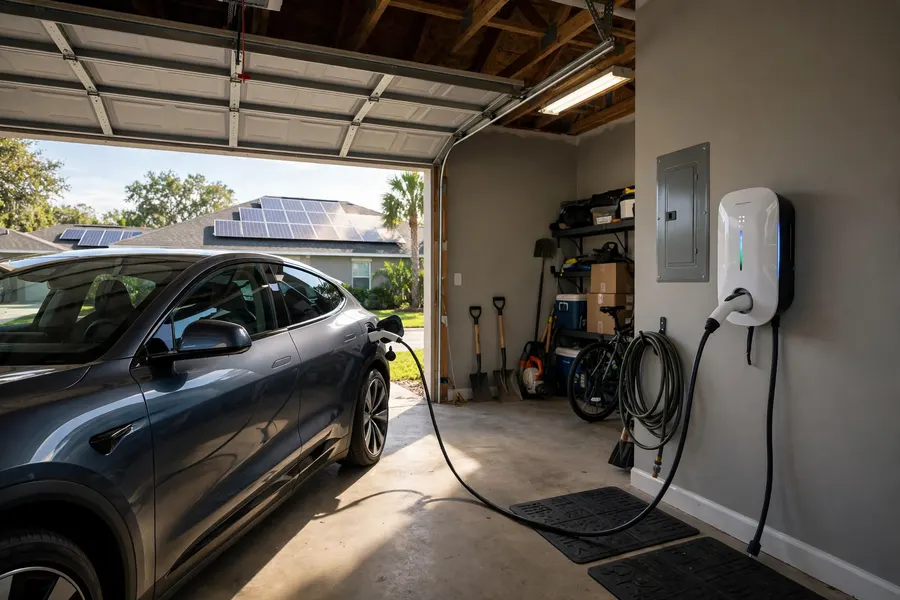
Rooftop solar is common across Gainesville's newer suburbs and increasingly present in town, and solar EV households ask one good question: how do the roof and the car share the day? The honest mechanics are simple. A grid-tied charger does not run off your panels during an outage, and a car that leaves at eight in the morning cannot charge from noon sunshine. What scheduling can genuinely do is shift sessions into production hours when the car is home — weekends, work-from-home days, a second car that stays — so more of the charging energy is your own.
Under GRU net metering, the accounting runs through GRU's terms rather than any other utility's program rules, and no other utility's exclusions travel with it. We configure timers and amperage around your production pattern and your driving pattern together, and describe plainly what the setup can and cannot do. Our solar and EV charging guide covers the Florida-wide picture; the Gainesville version is written under GRU's sky, which is generous with sun and equally generous with afternoon storms — one more reason surge protection earns its place in the conversation here.
How It Works
Step 1: Address and ownership first
City or county, owner or renter, EV model and where it parks. In Gainesville those answers decide the permit desk and the paperwork before anything else moves.
Step 2: Load calculation before hardware
Existing demand totaled, spare capacity shown as a number, charger and amperage chosen to fit the arithmetic — on paper, where you can see it.
Step 3: Permit and install day
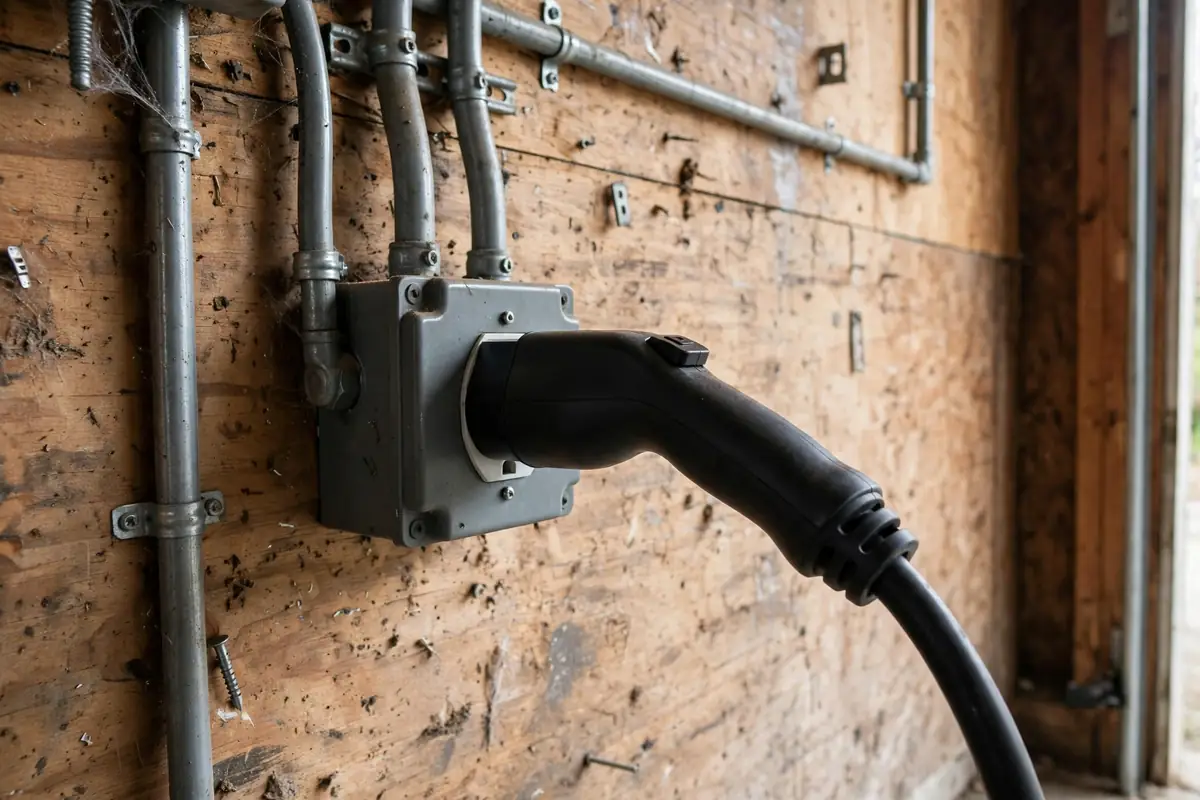
Permit filed with the city or county as your address requires, circuit built to the filed plan, charger mounted, configured, and tested with your car plugged in.
Step 4: Inspection and records
Inspection closes the permit. You receive the closed record, the configuration, and updated panel labeling — the documentation that holds up at sale and claim time.
On the Ground in Gainesville
Installs here cluster the way Gainesville itself clusters: historic streets around the Duck Pond where panels are old and permits matter most, neighborhoods feeding the university and Shands where owners and renters mix on the same block, southwest suburbs along Archer Road, and Haile Plantation out in the county where the permit desk changes but the standard does not. The constants are GRU service, two filing desks split by the city line, limestone country underneath, and a local debate about permits that this page has already settled. If your situation is the unusual one — a carriage house, a landlord negotiation, a panel someone else already touched without a record — describe it when you call through the contact page. Gainesville rewards the honest version of this work, and so does every future buyer of your home.
Questions to Ask Any Gainesville Installer
Ask five questions of anyone quoting here, including us: Will the circuit be permitted — city or county, matching my address — and will I receive the closed permit record? Will you run a load calculation before recommending panel work? What amperage will the charger be configured to, and what breaker and wire support it? What surge protection are you including for storm season? If any existing unpermitted work shows up in my panel, how will you handle it? The first question alone filters the field in this town. An installer who hesitates on it has told you how the rest of the job will go.
Frequently Asked Questions
Does a home EV charger really need a permit in Gainesville?
Yes. A new charger circuit is permitted electrical work here — through the City of Gainesville for city addresses and through Alachua County for unincorporated ones, including Haile Plantation. The permit closes with an inspection, and that record is what protects you when the home sells or an insurance claim ever touches the electrical system.
What actually goes wrong with unpermitted charger work?
It surfaces later, at worse moments: a buyer's inspector flags an undocumented 240-volt circuit at sale, an insurer asks for records after an electrical claim that do not exist, or the next electrician has to undo and redo work before starting their own. Permitting at install time is the inexpensive version of every one of those conversations.
Does GRU offer a rebate or charger program for my install?
We make no rebate or program claims on GRU's behalf. The established route in Gainesville is owning your charger through a private, permitted install on your own panel. GRU's net metering does exist for solar households, under GRU's own terms — that much is a matter of public record and belongs in solar planning.
I have solar — does the FPL solar exclusion affect me in Gainesville?
No. That exclusion belongs to FPL's EVolution subscription program, and Gainesville is GRU territory, not FPL. Your solar and your charger coexist under GRU's net metering. The real planning work is scheduling — aligning charging sessions with production hours when the car is home.
Can my Duck Pond home's older panel support a charger?
In many cases yes, and the load calculation is how we find out rather than guess. Options run from a full-rate circuit where capacity allows, through a moderately configured charger or load management, to panel work only where the numbers require it. Anyone quoting replacement before calculating is skipping the step that protects your budget.
I rent near UF — what are my options?
Start with your landlord's written agreement; without it, a new circuit cannot be installed. With it, landlords near the university and Shands increasingly treat a permitted charger as an asset that helps the house compete for long-stay tenants. Bring us the agreement and we will design the install as the property improvement it is.

Get Your Charger Installed in Gainesville
Permitted, inspected, and on the record from day one — one call books the assessment for your Gainesville home.
(407) 557-4153 · Mon–Fri 7:00 AM – 10:00 PM · Sat 8:00 AM – 10:00 PM · Sun 7:00 AM – 9:00 PM ET